
NLG Artists Talks: An Interview with Katherine Jackson
12 June 2026
Katherine Jackson (born 1998) lives and works in the Somerset countryside, near the Quantock Hills. She will be joining the NLG as our guest artist for the third annual Landscape Immersive on Hampstead Heath.
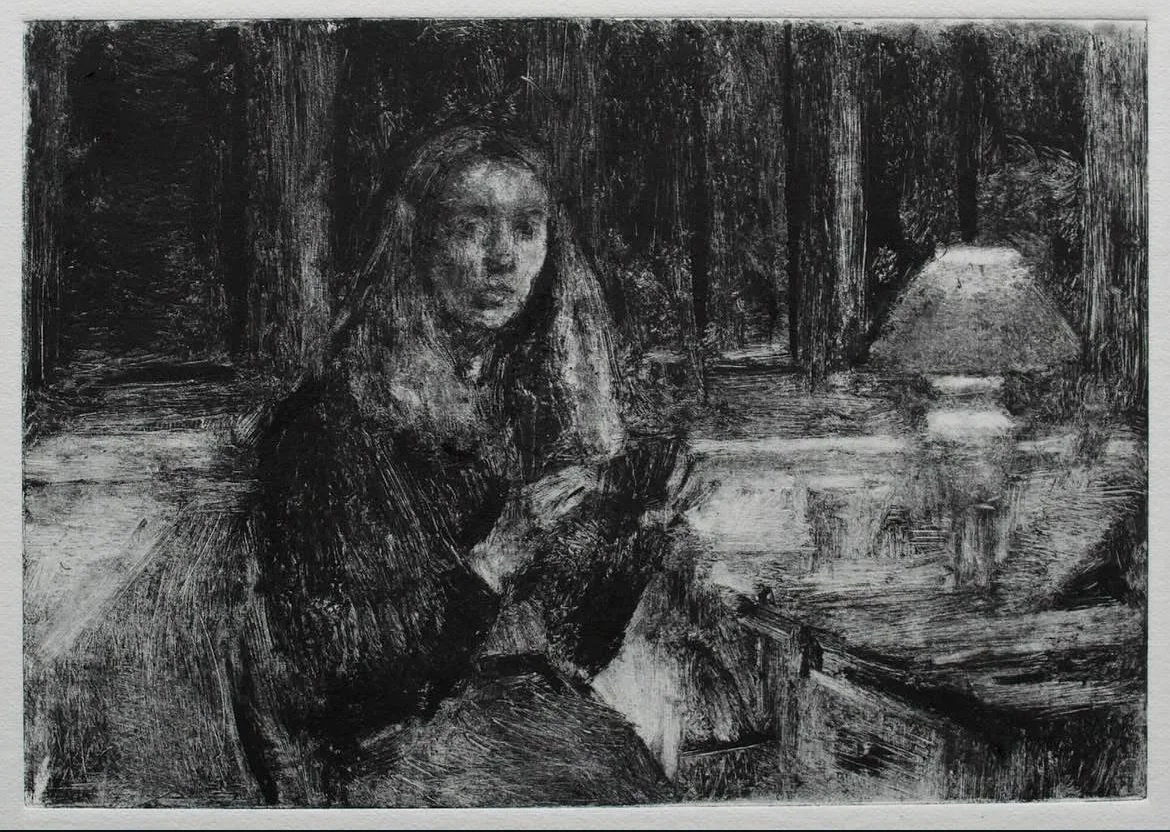
Self Portrait at night, 2025
Joshua Press: Katherine, thank you so much for joining me for this interview. I wanted to start by asking about your earliest memories of art. When did you first become aware of painting? At what age did you make your first works, and who were your earliest inspirations?
Katherine Jackson: When I was very young I liked to spend long periods of time alone imagining things, and initially drawing was just an aspect of that. I think most people draw at a young age, but then we become self-conscious about it and it gets harder. I remember that I considered giving it up, at around the same time it became difficult to play imaginative games (when I was about ten), but then I had an illness that kept me quietly inside for a time, and I spent the days drawing. I decided that I wanted to be an artist. My first paintings were watercolours; someone had given my mum a set, which I unearthed from a cupboard, and she kindly let me use them.
I remember visiting Paris when I was eleven or so, with my grandparents. They’d become lost and surrendered navigational responsibilities to my thirteen-year-old sister, but we found our way to the Musée d’Orsay. Though I can’t recall exactly what I saw, my memory is of an intense sensory experience of paintings bristling with light and colour, and of a feeling of excitement. I know now that I must have been looking at Impressionist and Post-Impressionist paintings. The only image that has remained in my mind from the visit was a Van Gogh of some houses (Thatched Cottages at Cordeville). I remember being fascinated by the peculiar lushness of the paint, and that I thought about it for a long time afterwards.
Joshua Press: We live in an era where there is relatively little traditional arts education. How did you find your way into figurative painting? Did you receive any instruction or guidance early on?
Katherine Jackson: I did find it difficult – there seemed to be so little figurative painting in the degree shows I visited. I guessed it must in some way be discouraged, or at least not actively taught. I felt quite confused, because I knew it was what I loved.
On my foundation course I found most satisfaction in drawing from life – I was excited by the way an image could come directly out of an encounter with something or someone. I decided to study for a degree in drawing at Falmouth, having been swayed by finding out that the course offered the opportunity to do life drawing classes at least once a week (I believe it’s rather different there now, and I don’t know if this is still the case).
Studying drawing and the life classes in particular gave me more control over the images I was creating, and I felt very lucky to have found instruction, but I also missed painting. I wanted to use oil paint, and struggled to find the time to learn about it around my other studies. I met other students making beautiful figurative work, and I was always a little envious of the painters. I began painting seriously in 2020, once I’d finished my degree.
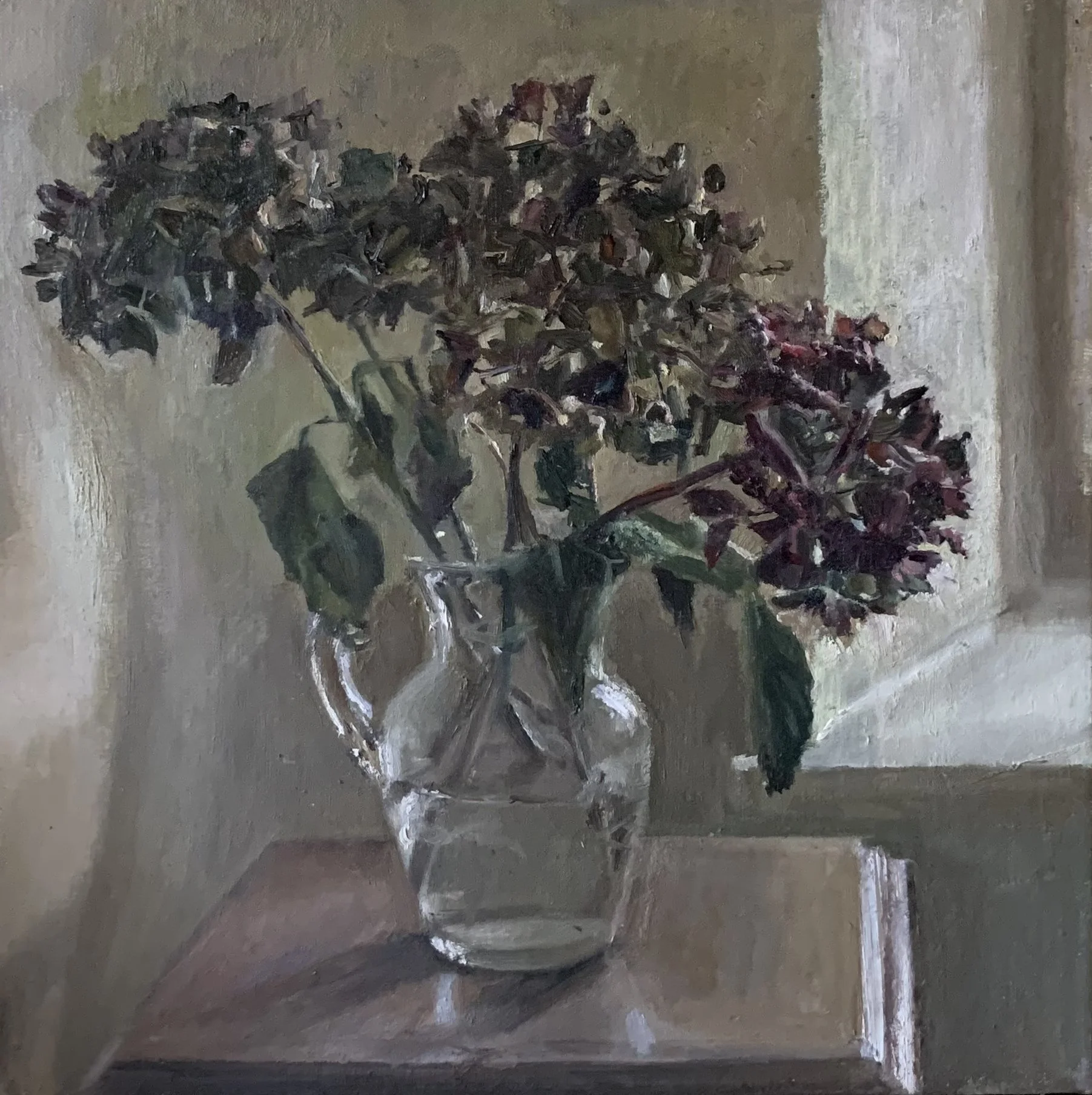
Hydrangea by a window, 2025
Joshua Press: What does your practice look like today? Do you have a studio and keep a regimented painting schedule? What are you currently working on? Do you tend to work on one painting at a time, or several simultaneously? I once interviewed the painter Alex Cohen, who mentioned that he can work on up to 100 paintings at a time (perhaps a slight exaggeration – I can't remember the exact figure!). Do you tend to work on paintings over long periods of time? And are you working from direct observation, memory, imagination, or photographic reference?
Katherine Jackson: At the moment I usually paint five or six days a week. I tend to work on several paintings at once, and I take a particular one out according to the time of day, the light and weather. They can take anything from a couple of hours to months to complete. I paint in a room in my parents’ house, or I go outside – I’ve always found dedicated studios a bit intimidating, especially when they’re blank white spaces. I like to have a subject in front of me.
I almost always work from life – I find it inspiring to be in the presence of whatever it is I’m working from. The experience of a subject through a photograph is more remote, and I find it hard to become engrossed in the same way.
I like to think that observational painting reflects an individual and human way of looking. I don’t necessarily mind, for instance, if my point of view migrates a little, or if I distort something – I think there’s often a beauty in the peculiarities that can emerge.
Another thing I find interesting about work made from life is the way in which people adapt the language of their painting according to the demands of the situation; there’s a relationship between the duration of the experience and the way the image appears (in the urgency or quietness of the marks, for example), so that directly observed works often seem to me to evoke a sense of time. Paintings made in gloomy conditions can become full of strange colours. There’s a feeling of contact with the reality the artist experienced as they painted.
I don’t know if I’ll always want to work entirely in this way – lots of painters I really admire also work away from their subject. When I visited the Sickert exhibition at the Tate a few years ago I was interested to see the photographs he worked from; of course they contained less information than a high-resolution digital photograph, and I wondered if that might in some ways be beneficial, in forcing you to have an imaginative involvement with the image.
At the moment I’m trying to take advantage of the subject matter for still-life paintings that the garden produces at this time of year.
Joshua Press: What colours are on your palette, and what informed those choices?
Katherine Jackson: My palette is still evolving – I’m always impatient to be painting and my material choices are usually made quite inefficiently, through trial and error, and the occasional recommendation from helpful friends. For a long time I used process colours (cyan, magenta and yellow, alongside white), but then I won a paint voucher and chose quite an extravagant selection. My palette since has been made up of the colours I found myself reaching for most often: ultramarine blue, phthalocyanine blue lake, pale violet, scarlet lake, brilliant pink, magenta, alizarin crimson, Venetian red, green gold, phthalocyanine green lake, sap green, raw umber, raw sienna, yellow ochre, and titanium white.
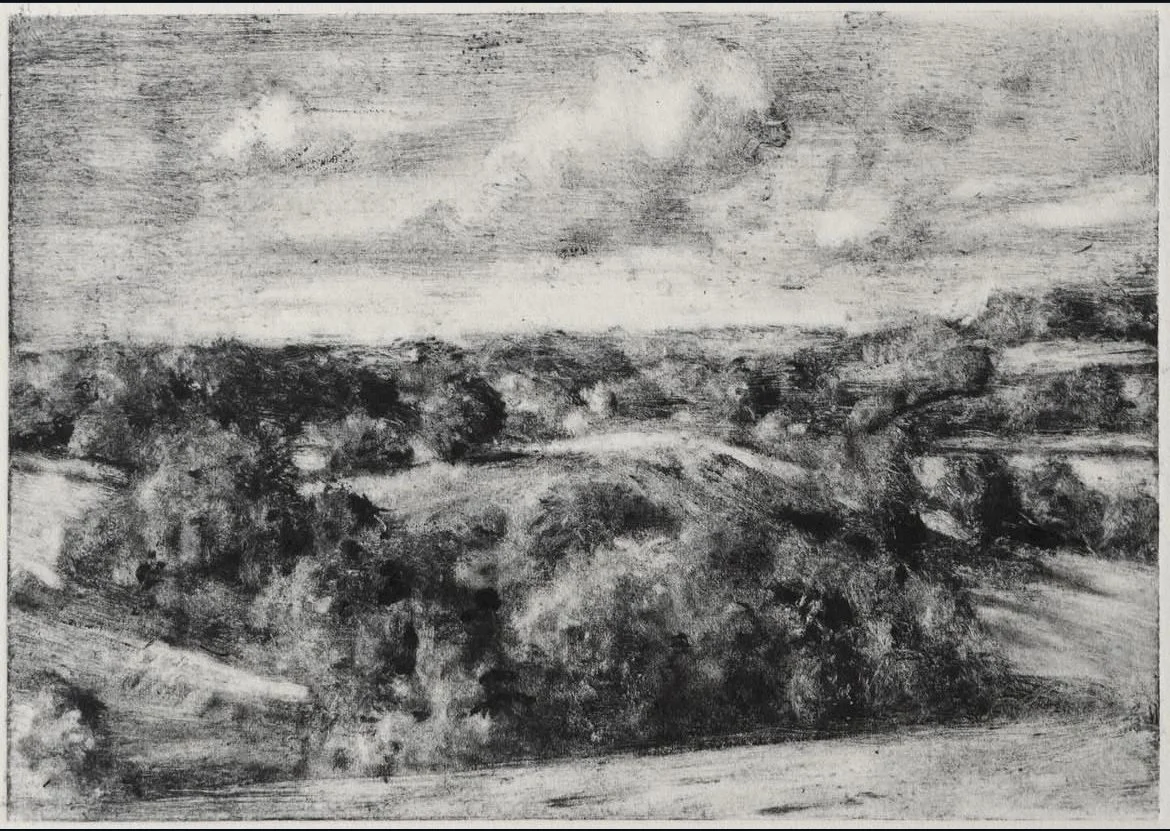
Morning view from the village, 2025
Joshua Press: You've been making beautiful monotypes recently. How did these come about? Have monotypes influenced your painting practice, and how do you distinguish them from drawing?
Katherine Jackson: Thank you very much! I had an urge to do some printmaking, and I chose to make monotypes because I’m drawn to images that are purely tonal, and because it was practical – it’s easy for me to ink a perspex plate out in a field, work on it there for a few hours, and then bring it home to print. I have a small tabletop press, and carry the inked plates about in a plastic box.
I hope that my monotypes will begin to affect my paintings, but I’m not sure that it’s happened yet. When you make a monotype you can’t allow the ink to dry, so things have to be described quickly and economically. When I consider some of the paintings I find the most beautiful they often (although not always) have a pared-back quality, which is sometimes the result of urgency; the subject seems to have been summoned from an accumulation of marks, and the traces of the artist’s tools and the gesture of their hand are legible. You can find it, for example, in Constable’s oil sketches, which feel so full of wind and light, but also of the movement of his brush across the page. You’re aware of both the illusion and the process by which it’s been created, and the image contains (to my mind) just enough information to be particularly evocative.
Making a monotype is for me very much like making a tonal drawing, although I do think that I’m someone whose drawing is in some way helped along by the language of print. I think, like a lot of people, I enjoy the way that chance enters into the process of printmaking – it can be frustrating, but at times the marks will be unexpectedly beautiful, and I’ll feel I’ve got more out of the process than I put in.
Joshua Press: How much of your practice is devoted to drawing? Do you keep a sketchbook?
Katherine Jackson: Most of the drawings I do are brief compositional diagrams, made as preparation for paintings, although I do use a sketchbook from time to time and make more developed drawings from life. Sometimes I draw directly onto a canvas, and the drawing becomes the underlying structure for the painting.
Joshua Press: If you had to cite three major artistic influences that inform your work, who would they be? (For example: Freud, Degas, Titian.)
Katherine Jackson: I think they would have to be Gwen John (a favourite I’ve returned to year after year), and at this particular moment Lucian Freud, and Sickert (I find his use of tone wonderfully evocative).
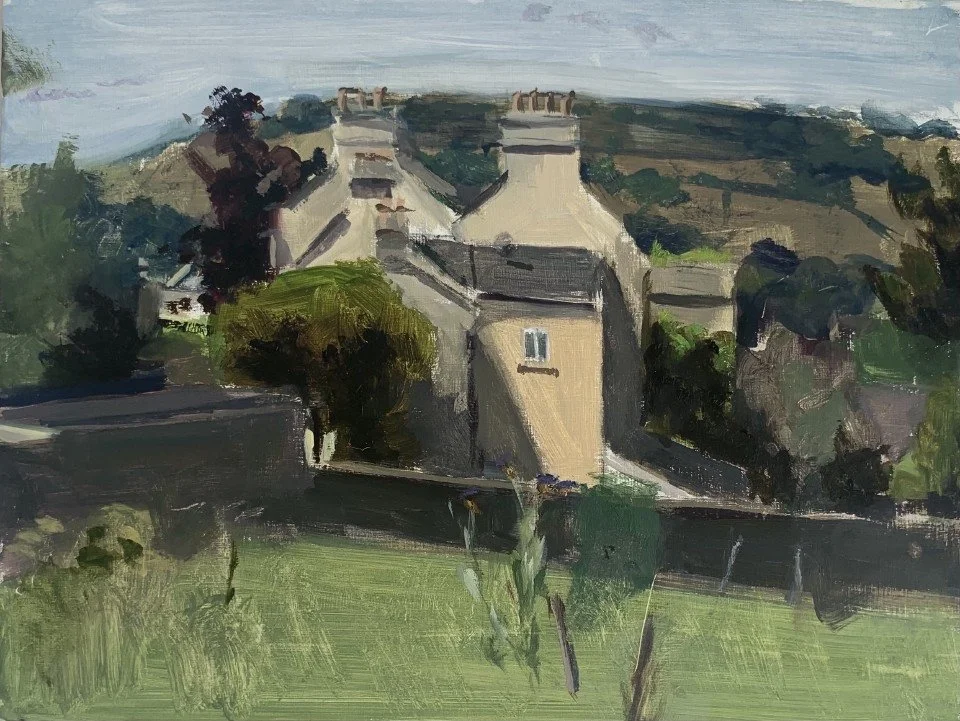
View of Solisbury Hill, 2022
Joshua Press: Outside of painting, where else do you find interest and inspiration?
Katherine Jackson: I enjoy reading, and I like to walk around the countryside near my house. I saw somewhere that your focus is better after a walk, and that you are more creative, and now I’m quite superstitious about it and think that if I don’t go I won’t paint well that day. I’m not sure whether any of that is true, but I do think it stops me from fidgeting.
Joshua Press: What is your best advice for painters who are early in their practice?
Katherine Jackson: I think that’s quite a tricky question, because everyone’s way of painting is so individual, and it’s easy to mistake something which helped you as universally helpful. I have an awful lot to learn myself. Part of my advice would probably be to keep an open mind, and not to become too attached to any one set of rules – there are many wonderful paintings in the world, often arrived at in very different ways.
That said, I am also going to recommend drawing from life – I think at the outset it is very helpful to have a separate drawing practice, even if later it becomes subsumed into your painting process. I think of drawing as the structure on which you can build other things.
I also think that drawing directly from life helps you to find your own particular way of going about things – you have to be quite selective, and sometimes your drawings will reveal to you what you find interesting about a subject. There’s a kind of freshness which can come from observing the world around you.
Day to day, I’ve personally sometimes found it necessary to allow my work to develop quietly and in private before showing people, and I think it’s good to seek out advice from people whose work you admire if you can. I also think that in order to work you particularly need a kind of privacy of mind, which might mean staying away from phones and social media while you are painting – I know this isn’t always easy.
Joshua Press: We're very excited to have you painting alongside us in the landscape this summer. What is your relationship to landscape painting? You live in the countryside in Somerset – does this particular part of England inspire you? Have you taken your easel further afield before?
Katherine Jackson: Thank you, it will be lovely to join you all! I think I’m interested in the way that light animates a landscape – there’s a fascination in the way light and shadow play over vast spaces. Trying to note down a particular moment feels impossible but exciting.
I haven’t really chosen this particular countryside, it just happens to be the part of the world where I grew up, and returned to after university. I do think there’s something interesting about painting the landscape you inhabit – I think you get to know it more deeply. Since I’ve begun painting here it seems full of landmarks – you become familiar with the rhythm of the hedges on a particular hill, or the shapes of individual trees, and you know how they might look at a given time of day, and when you might want to seek them out. I do think that a small area can provide you with endless interest.
I have made a couple of trips with my easel, both to gardens, a beautiful one in Derby and then at my Granny’s house. I’ve never painted in another country. I think it’s a lovely way to get to know a new place too – you learn the place by trying to describe it.
Joshua Press: A final question. We've already spoken several times about your inspirations in this short interview. If we could narrow it down to a single painting – I appreciate that this changes regularly for most painters – which work have you found yourself thinking about most recently, whether in the studio or outdoors? What are the particular qualities of that painting that continue to speak to you?
Katherine Jackson: I think it would have to be a Gwen John painting. She’s been a favourite of mine since I was a teenager, but I’ve been thinking about her particularly because of the wonderful Strange Beauties show at the National Museum in Cardiff. I feel I could almost choose any of her paintings, but I will go for Woman with a Coral Necklace.
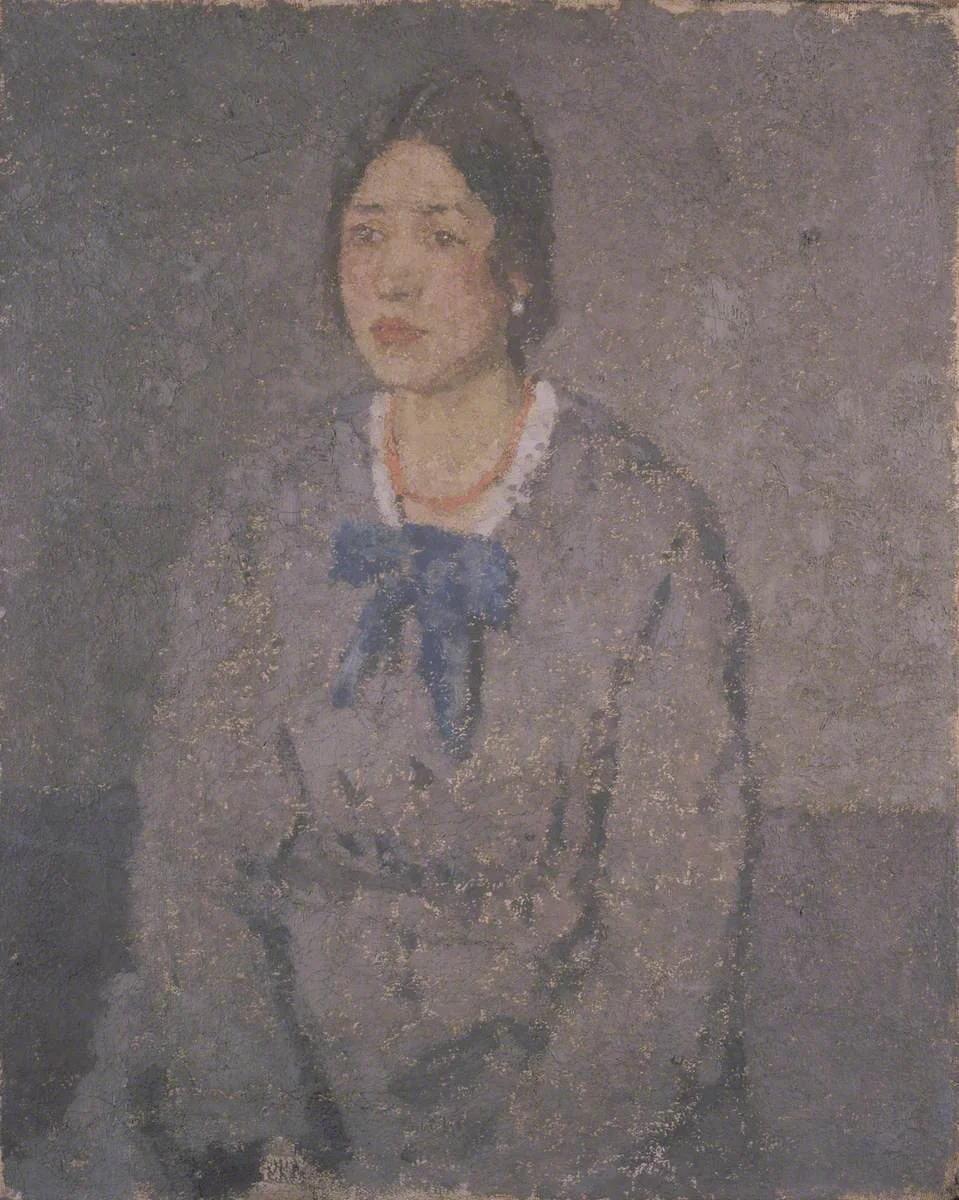
Woman with a Coral Necklace
I love the way she’s treated the surface equally, in little dabs of paint – the face and dress of the woman and the wall are all described in the same terms. It seems to mirror the way light is received by our eyes; it’s as though she’s perceived her subject as a kind of optical shimmer, without really concerning herself with the physicality of what was in front of her. (It made me smile to read that she called this technique ‘blobbing’; it’s a modest term for so beautiful a thing).
At the same time the woman has an intense presence, and the painting feels full of empathy – a more elusive thing, difficult to explain in technical terms.
I really admire her clarity when choosing a subject – her compositions are so sparse and exact, with nothing unnecessary in them. A deeper, purplish-grey shape crossing the bottom third of the image seems to describe the floor, and creates a sense of depth.
It’s a very close-toned painting, but there is a wonderful sense of luminosity. The woman in the painting is lit from the front, and though you can’t see a window I wonder whether one is implied by the way the light is washing her face. It’s interesting to think that in subtle ways a description of light might have narrative or psychological possibilities, in this instance giving the idea of someone looking out at the world from a shadowed space.
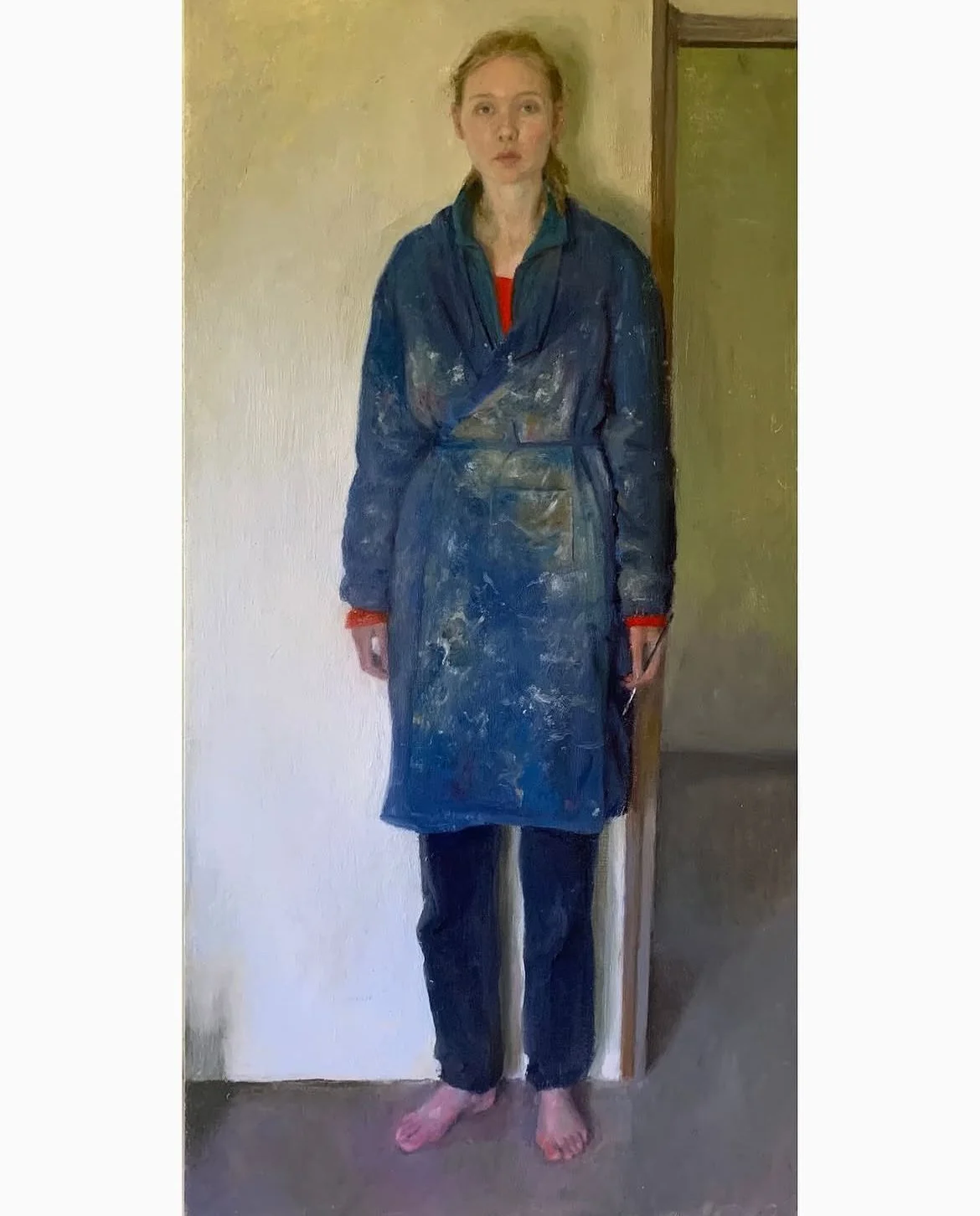
Self Portrait in a painting overall, 2022